
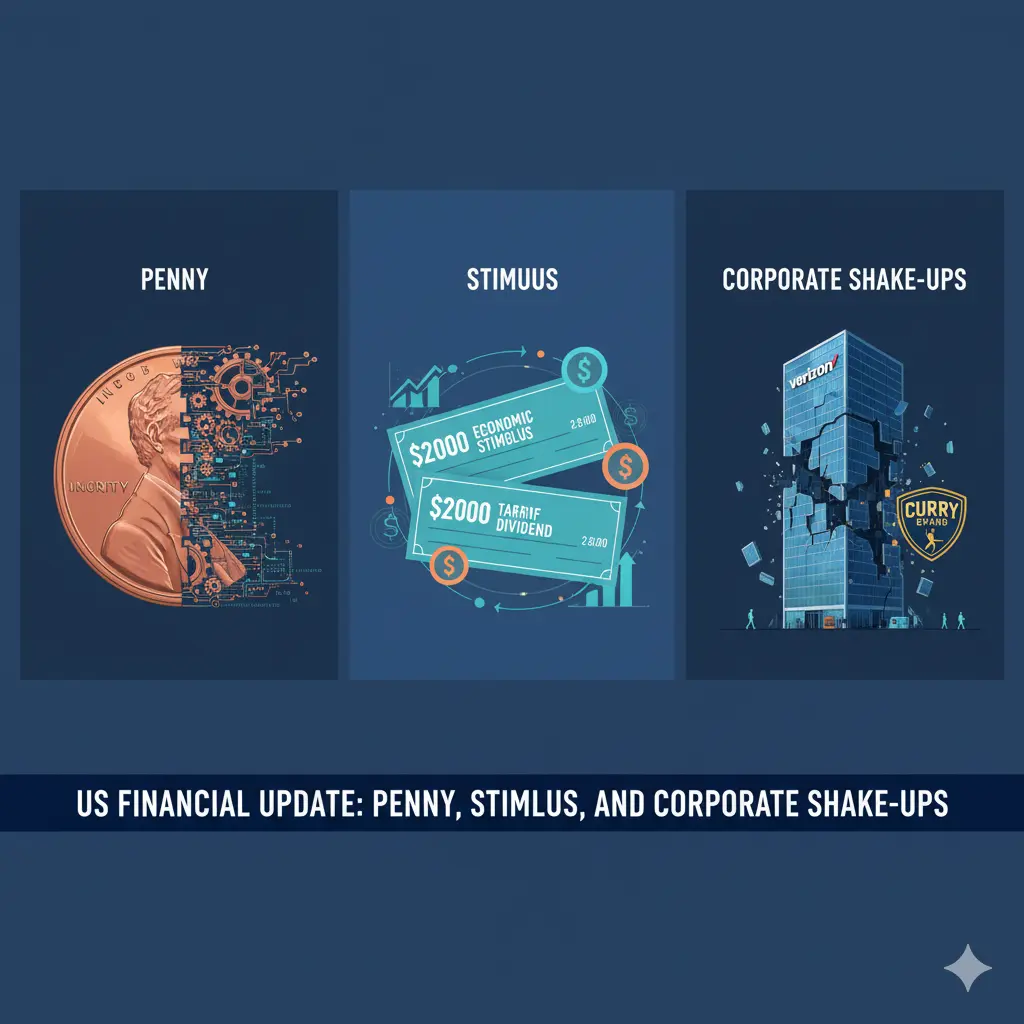
The financial landscape of 2025 has been dramatically reshaped by a decisive move on the penny and major corporate shifts. This updated Q&A breaks down the facts on currency, government payments, and business headlines.
The End of an Era: The US Penny
1) Is the Penny Really Discontinued in the US? What the Copper Coin’s Future Means for Your Wallet
No, but effectively, yes. The United States penny has not been officially removed as legal tender by Congress, but its production for general circulation has been halted by a Presidential order effective November 2025. – (Please read: FAQ by US Mint)
- Legal Status: The penny remains legal tender. You can still use it, and businesses are legally required to accept it.
- Production Status: On November 12, 2025, the U.S. Mint struck the final circulating one-cent coin in a ceremonial event. This marks the end of 232 years of continuous production for the coin.
- Impact on Your Wallet: The 114 to 300 billion pennies already in circulation will gradually be pulled out by banks and through natural attrition. For cash transactions, retailers are currently managing the lack of new coins by asking for exact change or implementing their own rounding systems. Official, mandated rounding to the nearest five or ten cents awaits an act of Congress.
2) When Will the US Stop Minting the One-Cent Coin?
Circulating production has already ceased. The decision to stop minting was made by the Treasury Department following a February 2025 directive from the President, citing the rising cost of production.
- Final Circulating Strike: November 12, 2025.
- Full Elimination: The final step—officially removing the penny as legal tender and implementing a universal rounding system for cash transactions—still requires an act of the U.S. Congress. This legislative action is expected in the near future to formalize the coin’s phase-out, similar to the successful model used in Canada.
- Collector Coins: The U.S. Mint will continue to produce special numismatic (collector) versions of the penny in limited quantities for historical and auction purposes.
3) The High Cost of the Penny: US Mint Production Costs vs. Face Value
The decision to halt production was driven entirely by the coin’s economic unsustainability—a phenomenon known as “negative seigniorage.”
| Denomination | Face Value | Cost to Produce (FY 2025 Est.) | Annual Taxpayer Loss (Est.) |
| Penny (1¢) | 1.00¢ | 3.69¢ | $\approx$ $56 Million |
| Nickel (5¢) | 5.00¢ | $\approx$ 14.00¢ | N/A (Still in production) |
- Current Loss: According to the U.S. Mint’s final reports, the cost of producing and distributing a single penny has risen to an estimated 3.69 cents, resulting in an annual loss of approximately $56 million for U.S. taxpayers.
- Raw Materials: The penny’s composition (97.5% zinc, 2.5% copper plating) has been subject to volatile commodity price increases, making the cost of the metal alone far exceed its one-cent face value.
- The Nickel Problem: While the penny is gone, the nickel (composed of 75% copper and 25% nickel) still costs over 14 cents to produce, keeping the debate on circulating currency costs alive.
Government Payments: Stimulus and Tariff Dividends
4) $2,000 Stimulus Check: New Proposal Details and When Congress Will Vote
As of late 2025, the $2,000 payment remains a high-profile proposal, not passed law, and is often conflated with the proposed “Tariff Dividend.”
- Source of Funding: This specific payment is proposed as a direct, one-time economic relief payment, but lacks a clear, passed funding mechanism.
- Eligibility (Proposed): Similar to previous stimulus rounds, it would likely target U.S. citizens and resident aliens under a certain Adjusted Gross Income (AGI) threshold, with phased-out payments for higher earners. Income caps used in past rounds were typically $75,000 for individuals and $150,000 for married couples.
- When will Congress vote? No vote has been scheduled. The proposal faces substantial political obstacles related to its estimated multi-hundred-billion-dollar cost and impact on the national debt.
5) $2000 Tariff Dividend Check: Who Qualifies and How to Claim Your Payment
The $2,000 Tariff Dividend Check is a separate but similar concept, actively promoted by the administration, which would distribute revenue collected from new tariffs (taxes on imported goods) directly to American citizens.
- Official Status: This is not an active government program with approved funding or a set distribution date. It is a policy proposal being explored by economic advisors.
- Who Qualifies (Proposed): White House officials have suggested that the payment may target families earning less than $100,000 per year.
- How to Claim: There is currently no application or claims process. All official government sources (IRS, Treasury) advise citizens to ignore any emails, texts, or social media messages claiming to facilitate an early claim for a Tariff Dividend. This is a common scam vector. The dividend may ultimately be delivered through tax cuts (e.g., no tax on tips/overtime) rather than a direct check.
📉 Major Corporate Moves: Tech, Telecom, and Brand Split
6) Verizon Layoffs 2025: Full Details on Job Cuts and Stock Market Impact
In late 2025, Verizon announced one of its largest workforce restructurings to date as part of an aggressive cost-cutting strategy in the face of slowing wireless growth and intense competition.
- Job Cuts: Verizon is planning to cut an estimated 15,000 to 20,000 jobs, which could affect up to 15% of its U.S. workforce. The cuts are heavily focused on non-union management, administrative, and legacy technology roles.
- Retail Strategy: A key part of the move is the conversion of a large number of company-owned retail stores into franchised outlets, effectively shifting store staff off Verizon’s direct payroll.
- Stock Market Impact: For investors, massive layoffs are often viewed positively in the short term, as they signal management’s commitment to “streamlining operations” and boosting profit margins. Verizon’s stock experienced a modest rise following the announcement, though long-term success depends on their ability to reinvest savings into 5G/6G infrastructure and competitive plans.
7) Steph Curry’s Under Armour Deal: Analyzing the Billion-Dollar Partnership
Update: The partnership has been terminated. The much-hyped, long-term partnership between Stephen Curry and Under Armour, which was previously valued as high as $$$1 billion, has come to an immediate and mutual end. (Read: Press Release)
- The Split: On November 13, 2025, Under Armour and Stephen Curry announced their plans to separate the “Curry Brand” from Under Armour.
- Reasoning: Under Armour stated the move was part of its strategy to focus on its “core UA brand” amid a turnaround effort and broader restructuring. Curry is now free to pursue a new retail partner, taking the independent Curry Brand with him.
- Legacy Impact: The partnership, which included equity for Curry, successfully launched the “Curry Brand” and built a platform for community investment, but the expected $$$1 billion in value will not be realized under the original terms. The final collaborative shoe, the Curry 13, is scheduled for release in February 2026.
💳 Federal Payment Tracking
8) IRS Direct Deposit Update: Status Check for Your Stimulus or Tax Payment
The IRS Direct Deposit system remains the fastest and most secure method for receiving any federal payment, including tax refunds or future stimulus/dividend payments.
- The Official Tool: The sole, official way to track the status of your payment is the “Where’s My Refund?” portal on the IRS.gov website.
- Information Required: To use the tool, you must provide:
- Your Social Security Number (SSN) or Individual Taxpayer Identification Number (ITIN).
- Your Filing Status (e.g., Single, Married Filing Jointly).
- The exact whole-dollar amount of the refund/payment you are expecting from your tax return.
- Tracking Timeline: The tool generally updates once per day, usually overnight. You can start checking the status 24 hours after e-filing your tax return.
- Security Reminder: The IRS will never initiate contact with you via email, text, or social media to verify personal or banking information for a payment. Any such contact is a scam.
Standard Comprehensive Disclaimer (Recommended)
Disclaimer: Information Accuracy and Financial Advice
The information provided in this article is for general informational and educational purposes only. While every effort has been made to ensure the accuracy and currency of the facts presented—especially the time-sensitive updates regarding the US Penny and the Steph Curry/Under Armour deal—the financial and legislative landscapes are subject to rapid change.
This article does not constitute financial, legal, investment, or tax advice. You should consult with a qualified professional (such as a financial advisor, tax specialist, or attorney) before making any decisions based on the information provided herein. The author and publisher are not liable for any losses or damages arising from the use of this content.