
Introduction
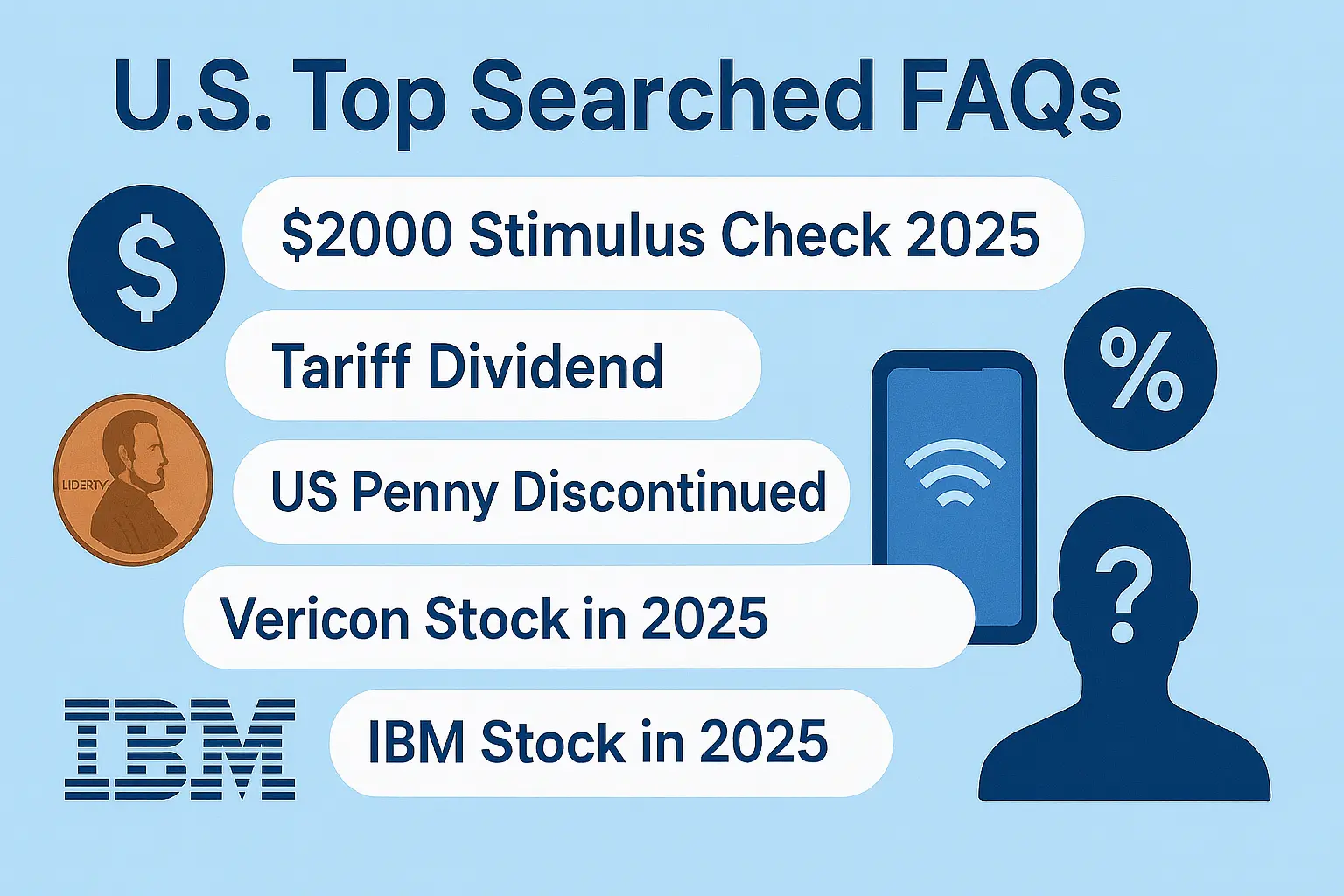
Via FAQs, Americans are seeking clear answers on a range of financial topics, from a proposed government payment to the fate of the penny and specific stock forecasts. This FAQ addresses the top trending searches, separating official facts from political proposals and market speculation to provide a clear and accurate financial overview.
The Proposed $2,000 Payment: Stimulus and Tariff Dividend
Q1: Is a new $2,000 stimulus check being sent out by the government?
No. As of November 2025, no new federal stimulus checks have been authorized or approved by Congress. The Internal Revenue Service (IRS) has confirmed there are no new relief payments scheduled. Discussions about a $2,000 payment refer to a political proposal, not an enacted law.
Q2: What is the proposed $2,000 “Tariff Dividend”?
The $2,000 Tariff Dividend is an economic proposal from the Trump administration. It suggests distributing money to American citizens, funded by revenues collected from tariffs on imported goods. The proposal frames this as a “dividend” returned to the people rather than using the funds for other government purposes.
Q3: How would the proposed Tariff Dividend work?
The proposal’s mechanics are not finalized. It could be distributed as a direct check or deposit, but administration officials have also suggested it might be delivered through tax benefits, such as eliminating federal tax on tips, overtime income, or Social Security benefits, or through increased deductibility for certain expenses.
Q4: Who would be eligible for the proposed $2,000 payment?
The proposal aims to provide relief to low- and middle-income Americans while excluding “high-income people.” While no official threshold is set, administration officials have suggested a limit of family income under $100,000 per year, similar to past relief efforts. Final eligibility would be determined if the proposal becomes law.
Q5: What are the main challenges facing the proposed Tariff Dividend?
The proposal faces several significant hurdles:
- Funding: Expert analyses suggest the projected cost of the payments may exceed current annual tariff revenues.
- Legislation: Depending on its final structure, it would likely require approval from Congress, which is not guaranteed.
- Legal Review: The Supreme Court is reviewing the legality of the tariff authority that would fund the plan. A ruling against the administration could invalidate the funding source.
Q6: What is the status of this proposal in Congress?
There is no specific bill for a $2,000 stimulus or tariff dividend currently making progress in Congress. The concept remains an executive branch proposal. For any direct payment to be issued, Congress would need to pass legislation to approve and fund it, a process that has not yet begun.
Q7: How can I avoid scams related to this proposed payment?
The IRS will never call, text, email, or contact you via social media to ask for personal or banking information for a payment. Any communication urging immediate action to “claim” a check is a scam. Official information will only come from verified government websites like IRS.gov or the U.S. Department of the Treasury.
Q8: How can I ensure the IRS has my correct direct deposit information?
The primary method is to file your annual federal tax return (Form 1040) and request your refund via direct deposit. The IRS uses the banking information from your most recent return. If a future payment is authorized, the IRS may re-activate a tool like the “Get My Payment” portal for updates.
Q9: How does this proposed payment compare to past government dividends?
Unlike the deficit-funded COVID-19 stimulus checks, this proposal is tied specifically to tariff revenue. It is also similar in concept to the Alaska Permanent Fund, which distributes state oil revenues to residents, but on a national scale. However, it remains a proposal, not an active program.
The U.S. Penny: Discontinuation and Value
Q10: Is the U.S. penny still being produced?
No. The U.S. Mint has suspended production of new circulating one-cent coins following a determination by the Treasury Department that they are no longer necessary due to high production costs.
Q11: Are pennies still legal tender? Can I still use them?
Yes. All pennies already in circulation remain legal tender. You can still use them for transactions, and businesses are required to accept them.
Q12: What will happen to cash transactions without new pennies?
The U.S. is expected to adopt “rounding” for cash transactions. The final bill will be rounded to the nearest five-cent increment. For example:
- A purchase of $4.98 or $4.99 would round down to $4.95.
- A purchase of $5.01 or $5.02 would round up to $5.05.
This rounding applies only to cash payments; electronic transactions will still use the exact amount.
Q13: Why was the penny discontinued?
The primary reason was cost. It cost the U.S. Mint nearly 3.7 cents to produce each one-cent coin, resulting in an annual loss of tens of millions of dollars. Discontinuing production is forecast to save approximately $56 million per year.
Q14: Are any pennies valuable to collectors?
Yes. While most pennies are worth one cent, certain rare error coins are highly valuable to numismatists. Notable examples include the 1943 Copper Cent (struck on the wrong planchet), the 1944 Steel Cent, and the 1955 Doubled Die Obverse coin.
Q15: Does the U.S. Mint lose money on any other coins?
Yes. The nickel (five-cent coin) also costs more than its face value to produce, with an estimated cost of nearly 14 cents per coin. This results in a significant loss for the Mint with each nickel produced.
Stock Forecasts: Verizon (VZ) and IBM
Q16: What is the stock forecast for Verizon (VZ) in late 2025?
Analyst consensus on Verizon (VZ) is generally neutral-to-positive. The average 12-month price target is approximately $48.67. Many analysts rate it a “Hold” or “Buy,” citing its strong dividend yield and potential from its 5G network expansion. Some valuation models suggest the stock may be currently undervalued.
Q17: What factors are influencing Verizon’s stock outlook?
Key factors include:
- 5G Expansion: Significant investment in C-band spectrum is expected to drive growth through mobile service upgrades and Fixed Wireless Access (FWA) for home broadband.
- Financial Health: The company’s solid free cash flow supports its dividend and debt reduction.
- Risks: The stock faces pressure from intense competition, high capital expenditure, and a significant debt load.
Q18: What is the stock forecast for IBM?
The outlook for IBM has improved, with rising earnings estimates for 2025 and 2026. The company is focused on its Hybrid Cloud and Artificial Intelligence (AI) strategy, bolstered by its acquisition of Red Hat. The analyst consensus often leans toward “Hold,” reflecting a cautious optimism as the company transitions its business model.
Q19: What are the strengths and risks for IBM’s stock?
- Strengths: A large enterprise client base, a strong consulting division, and leadership in quantum computing research.
- Risks: The company faces stiff competition in cloud services from giants like Microsoft and Amazon, and it must continue to manage the decline of its legacy business units.
Cryptocurrency: Satoshi Nakamoto
Q20: Who is Satoshi Nakamoto?
Satoshi Nakamoto is the pseudonymous person or group who created Bitcoin, authored its original white paper in 2008, and developed the first Bitcoin software. Their true identity remains one of the internet’s greatest mysteries.
Q21: What did Satoshi Nakamoto do?
Key actions included:
- Publishing the Bitcoin white paper outlining a “peer-to-peer electronic cash system.”
- Mining the “Genesis Block” (Block 0), which contained a hidden message commenting on the banking system.
- Collaborating with early developers before gradually ceasing all communication and disappearing from public view in 2011.
Q22: Why is Satoshi Nakamoto’s identity important?
The continued anonymity of Bitcoin’s creator is seen as reinforcing the decentralized nature of the cryptocurrency. It ensures that no single entity controls or exerts undue influence over the network, aligning with its core philosophical principles.
Disclaimer:
1. ⚠️ Government Payment & Policy Disclaimer (Points 1-16)
The information provided regarding the $2,000 Stimulus Check, Tariff Dividend, and related payment proposals (Points 1 through 16) is based on publicly available campaign proposals, statements from government officials, legislative debates, and financial analysis as of November 2025.
- Status of Payments: No $2,000 stimulus check or tariff dividend has been authorized, funded, or scheduled by the U.S. Congress or the Internal Revenue Service (IRS). All discussions around the payment, its amount, eligibility, and timing are speculative until a bill is passed into law and signed by the President.
- Funding & Legality: The feasibility of the “tariff dividend” is subject to ongoing legislative approval, judicial review of the underlying tariff authority, and financial analysis that questions the sufficiency of the funding source. The proposed payment structure may change significantly (e.g., from a direct check to tax cuts).
- No Guarantee: Readers should not rely on the information as a guarantee of future payment. Always consult the official websites of the IRS.gov and the U.S. Department of the Treasury for the only authoritative information regarding federal payments.
2. Currency & Numismatic Disclaimer (Points 17-20)
The information concerning U.S. coinage, including the Penny and the Nickel (Points 17 through 20), reflects historical facts and recent policy decisions by the U.S. Mint and Treasury Department.
- Legal Tender: While the production of the penny is suspended, all existing pennies remain legal tender and can be used for cash transactions.
- Valuation: Information on numismatic value (rare error coins) is based on historical market prices and collector demand. Actual value depends on the coin’s condition, grading, and current market trends and is not guaranteed.
- Policy: The details regarding the cost of production and the rounding rules for cash transactions are based on the latest available data from the U.S. Mint and may be subject to future policy adjustments.
3. 📈 Financial & Stock Forecast Disclaimer (Points 21, 22, 24)
The analysis and forecasts provided for Verizon (VZ) and IBM stock (Points 21, 22, and 24) and the discussion of their financial health and strategies are for informational purposes only and do not constitute financial advice.
- Not Investment Advice: This content is based on analyst consensus, company reports, and market metrics (PE ratio, DCF, price targets). It is not a recommendation to buy, sell, or hold any security.
- Market Risk: Stock prices are volatile. Forecasts are inherently uncertain and may change rapidly due to unforeseen market events, economic shifts, competitive pressures, and company-specific news (e.g., earnings misses, successful product launches).
- Consult a Professional: Before making any investment decisions, readers should conduct their own thorough due diligence and consult with a qualified financial advisor.
4. 💻 Technology & Historical Disclaimer (Point 23)
The information regarding Satoshi Nakamoto and Bitcoin (Point 23) is based on historical records, published white papers, and common knowledge within the technology sector.
- Identity: The identity of Satoshi Nakamoto remains unverified and unknown. All claims regarding their identity are speculative.
- Accuracy: The information presented is accurate to the best of our knowledge at the time of publication but should be verified with primary sources for academic or legal purposes.